
How to Calculate Batting Average: Formula, Examples, and At-Bats
To calculate batting average, divide a player's hits by the player's official at-bats. The result is usually written as a three-digit decimal without a leading zero: 3 hits in 17 at-bats is .176 after rounding. This simple formula is useful only when the hits and at-bats cover the same player and the same period.
This guide explains how to calculate batting average for a game, a series, or a season. It also clarifies what counts as an at-bat, shows why a walk is not added to the denominator, and gives examples you can check with the batting average calculator. The goal is a result you can reproduce from a box score, not a mysterious number copied from a leaderboard.
The short answer: hits ÷ at-bats
The standard batting average formula is AVG = H ÷ AB. H means hits and AB means official at-bats. If a batter has 50 hits in 180 at-bats, the calculation is 50 ÷ 180 = 0.2777..., which is displayed as .278 when rounded to three decimal places.
The batting average formula
Batting average measures how often an official at-bat ends in a hit. The calculation is a ratio, so it is not the same as a percentage of all plate appearances. Write the formula as AVG = H / AB, place the hit total on top, and divide by the at-bat total. A result of .300 means 300 hits per 1,000 at-bats in a mathematical sense; it does not mean the player reached base safely in 30% of every plate appearance.
Keep the decimal form for baseball notation. A calculator may show 0.278 or 27.8%, while a scorecard normally shows .278. These are equivalent representations of the same ratio. Do not multiply by 100 and then write 27.8 as a batting average; use the decimal form when comparing baseball statistics.
When a question asks how is batting average calculated, the essential answer is still hits divided by at-bats. The important work happens before the division: confirm the official totals, match the time period, and apply the same rounding rule to every player or team being compared.
What counts as an at-bat?
An at-bat is an official statistical opportunity used in the batting-average denominator. It is narrower than a plate appearance. A batter can complete a plate appearance without receiving an at-bat, so copying the plate-appearance total into the formula will make the average too low.
Usually included in AB
- A hit of any type, including a single, double, triple, or home run.
- A strikeout, whether swinging or looking.
- An out made on a ball put into play.
- Some reaches on an error or a fielder's choice, according to the official scoring decision.
Not included in AB
- A base on balls, commonly called a walk.
- A hit by pitch.
- A sacrifice bunt or sacrifice fly.
- Other scoring situations that end a plate appearance without an official at-bat.
Use the official box score or league record rather than guessing from plate appearances. Rules and scoring conventions can differ between baseball and softball competitions, and a scorer may change a decision after reviewing a play. For a published total, the league's official record is the reference point.
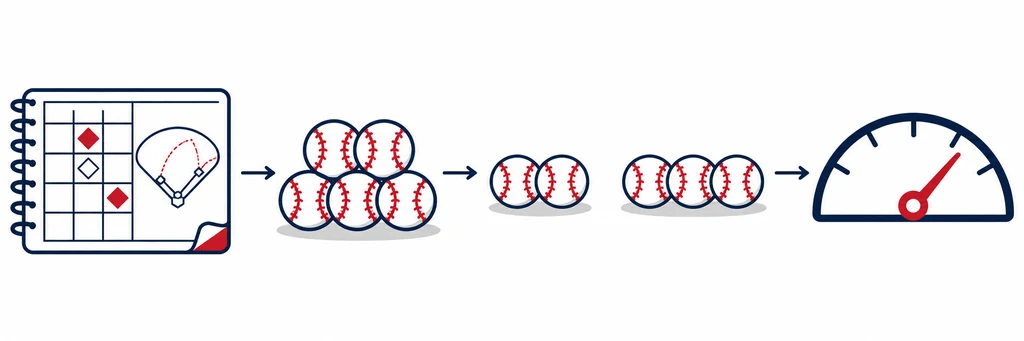
How to calculate batting average step by step
- Choose the time period. Decide whether you are measuring one game, a series, a month, a season, or a career. Do not mix a player's current season hits with career at-bats.
- Record official hits. Add singles, doubles, triples, and home runs. A walk or a sacrifice is not a hit for this formula.
- Record official at-bats. Use the same period and the same competition. If you only have plate appearances, find the official at-bat total before calculating.
- Divide hits by at-bats. Enter the full numbers into a calculator or spreadsheet:
hits / at_bats. - Round for display. Baseball scoreboards commonly show three decimal places. Keep extra digits in a worksheet until the final step so small samples are not distorted by early rounding.
- Label the context. State the period, league, and sample size next to the result. A .400 average over 10 at-bats needs a different interpretation from .300 over 500 at-bats.
Worked batting average examples
Example 1: 3 hits in 17 at-bats
For the common question “if you go 3 for 17, what is your batting average?”, divide 3 by 17. The unrounded value is 0.176470..., so the displayed batting average is .176. The phrase “3 for 17” already supplies both numbers; do not add walks or total plate appearances.
Example 2: 50 hits in 180 at-bats
Calculate 50 ÷ 180 = 0.277777.... Rounded to three decimals, the result is .278. If a report asks for a percentage, the same ratio is 27.8%, but keep the leading-zero decimal when you write the baseball statistic.
Example 3: 150 hits in 500 at-bats
Here, 150 ÷ 500 = 0.300 exactly, so the batting average is .300. The trailing zero matters because it shows the display precision. It should not be changed to .3 when the result is being compared with a standard baseball leaderboard.
Example 4: combine games instead of averaging game averages
Suppose a player goes 4 for 15 in one game and 3 for 12 in the next. Add the underlying totals first: 7 hits and 27 at-bats. The combined average is 7 ÷ 27 = 0.259259..., or .259. Averaging .267 and .250 directly would give .259 only by coincidence here; with different at-bat counts, a simple average of game averages can be wrong.
How to read a batting average
A batting average is most useful when you attach a time period and a comparison group. MLB's glossary notes that league-wide batting average has often hovered around .250, but league, season, park, era, and playing role all matter. A number that looks strong in one context may not be strong in another. Use current official league tables when you need a live benchmark rather than treating .250 as a permanent rule.
Sample size is just as important. A player can start a season 4 for 8 (.500) and then move quickly as more at-bats accumulate. For a stable evaluation, look at a larger sample and include playing time. When comparing teammates, make sure the totals cover the same season and competition level.
Batting average also has a defined blind spot: it counts every hit as one success regardless of whether it was a single or a home run, and it ignores walks. It is a clear measure of hit frequency per at-bat, not a complete summary of offensive value.
Batting average, OBP, and SLG
| Statistic | Core idea | What it adds |
|---|---|---|
| AVG | Hits ÷ at-bats | How often an official at-bat produces a hit |
| OBP | Times reaching base ÷ plate-appearance denominator | Includes walks and hit by pitch, subject to the official formula |
| SLG | Total bases ÷ at-bats | Gives extra-base hits more weight than singles |
These statistics answer different questions, so one should not be substituted for another. If you want to compare a player's ability to reach base, look at OBP. If you want to include the value of doubles, triples, and home runs, look at SLG. The slugging percentage calculator and ERA calculator cover related baseball measures on this site.
Common mistakes and calculator checks
- Using plate appearances as AB: remove walks, hit by pitch, and sacrifices according to the official record.
- Mixing periods: use hits and at-bats from the same game, season, or career span.
- Rounding too early: keep the unrounded division until the final display step.
- Writing a percentage as AVG: 27.8% is the same ratio as .278, but .278 is the conventional baseball display.
- Ignoring impossible inputs: hits cannot be greater than at-bats, and at-bats cannot be zero for a computed average.
- Reading a tiny sample as a full evaluation: report the hit and at-bat totals beside the decimal.
For a quick arithmetic check, enter the hits and at-bats in the batting average calculator. The calculator is useful for verification, while the official scorekeeping record remains the source for deciding which events belong in each total.
Frequently asked questions
What is the formula for batting average?
Batting average is hits divided by official at-bats: AVG = H / AB. Keep the totals from the same player and the same time period, then round the decimal for display.
What is the batting average for 3 hits in 17 at-bats?
Divide 3 by 17 to get 0.176470.... Rounded to three decimal places, the batting average is .176.
Do walks count as at-bats?
No. Walks, hit by pitch, and sacrifice plays are not added to the at-bat denominator under the standard batting-average definition. Check the official scorekeeping record for the competition.
Should I average a player's game averages?
Usually no. Add the hits and at-bats across the games first, then divide the combined hits by the combined at-bats. A simple average gives each game the same weight even when at-bat counts differ.
How many decimals should batting average use?
Baseball reports commonly show three decimal places, such as .278. Keep the unrounded value during calculations and round only the final displayed result.
Is batting average the same as on-base percentage?
No. Batting average counts hits per at-bat, while on-base percentage also accounts for walks and hit by pitch through its own official formula. They describe different parts of offensive performance.
Summary
To calculate batting average, divide hits by official at-bats, keep both totals within the same period, and round only the final result for display. The formula is simple, but the at-bat definition and sample size determine whether the answer is meaningful. For a primary-source definition, see the MLB batting average glossary; for a hands-on check, use the site's batting average calculator.
Editorial note: This guide was checked on November 15, 2026 against the MLB glossary and the official scoring concepts described in the cited baseball references. League rules and scoring decisions can change, so use the governing competition's record when an official statistic is required.